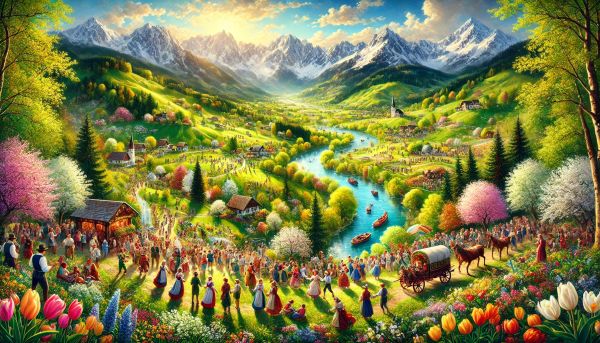
Beyond Winter: Exploring Goethe's Osterspaziergang Themes
As the grip of winter loosens and the world awakens with a vibrant burst of color and life, there's a universal human yearning for renewal. Few works of literature capture this profound transition with the eloquence and depth of Johann Wolfgang von Goethe's "Osterspaziergang" (Easter Walk). This iconic poem, embedded within the monumental drama *Faust. Der Tragödie erster Teil* (Faust I), stands as a testament to Goethe's multifaceted genius – a master poet, discerning scientist, and profound philosopher. Through its evocative lines, the poem invites us to witness not just the thawing of ice, but the spiritual and communal resurrection of humanity itself. Delving into
Der Osterspaziergang Text reveals layers of meaning that resonate as powerfully today as they did over two centuries ago.
The Dawn of Spring: Nature's Rebirth in *Der Osterspaziergang*
Goethe opens "Osterspaziergang" with a powerful and immediate image of nature's liberation: "
Vom Eise befreit sind Strom und Bäche" (From ice are freed stream and brook). This single line vividly paints a picture of melting ice, signaling the definitive end of winter's dominion. The "
holden, belebenden Blick" (gracious, enlivening gaze) of spring breathes life back into the landscape, transforming the dormant world. The valley, once bleak, now "
grünet Hoffnungsglück" (greens with the happiness of hope), intertwining the physical awakening of nature with a deep sense of emotional and spiritual optimism.
Goethe's keen observation, honed by his scientific pursuits, shines through as he describes the "
alte Winter in seiner Schwäche" (old Winter in his weakness) retreating to the "
rauhe Berge" (harsh mountains). He even humorously notes winter's feeble attempts to cling on, sending "
ohnmächtige Schauer körnigen Eises" (impotent showers of grainy ice) that are ultimately banished by the triumphant sun. The sun "
duldet kein Weisses" (tolerates no white), insisting on a world brimming with color. This section beautifully articulates the sheer vital force of spring, where "
Überall regt sich Bildung und Streben, alles will sie mit Farbe beleben" (Everywhere stirs formation and striving, everything wants to be enlivened with color). It’s a compelling portrayal of natural processes imbued with poetic grandeur, reminding us of the cyclical yet ever-renewing power of the seasons. For a deeper look into these natural themes, consider reading
Goethe's Osterspaziergang: Unpacking the Spring Awakening.
A Collective Awakening: Humanity's Escape from Urban Constraints
While nature undergoes its transformation, Goethe masterfully parallels this with a profound shift in the human experience. The second part of
Der Osterspaziergang Text depicts the mass exodus of city dwellers, bursting forth from their confined spaces into the open countryside. The city is portrayed as a place of physical and spiritual oppression: "
Aus niedriger Häuser dumpfen Gemächern, aus Handwerks- und Gewerbesbanden, aus dem Druck von Giebeln und Dächern, aus der Strassen quetschender Enge, aus der Kirchen ehrwürdiger Nacht" (Out of low houses' stuffy rooms, out of craft and trade's bonds, out of the pressure of gables and roofs, out of the streets' crushing narrowness, out of the churches' venerable night). These powerful images paint a picture of a society yearning for release.
The Easter holiday serves as the perfect catalyst for this liberation. People "
feiern die Auferstehung des Herrn, denn sie sind selber auferstanden" (celebrate the Resurrection of the Lord, for they themselves are resurrected). This parallel is key: the religious celebration of Easter becomes a metaphor for the secular, personal, and communal resurrection from the winter of their discontent and urban confinement. The "
buntes Gewimmel" (colorful throng) streaming from the "
hohlen, finstern Tor" (hollow, dark gate) symbolizes the return of life, energy, and community. Everyone wants to "
sonnt sich heute so gern" (sun themselves today so gladly), seeking not just physical warmth but spiritual solace and connection in the blossoming landscape. This aspect highlights a timeless human need for connection with nature and community, a practical insight that encourages us to seek out green spaces and social interaction as a means of personal rejuvenation, especially after periods of confinement or stress.
Faust's Contemplation: Inner Conflict Amidst Public Joy
It's crucial to remember that "Osterspaziergang" is not merely a standalone spring poem but a scene within *Faust I*. The central figure, Faust, accompanied by his famulus Wagner, observes this vibrant scene with a complex mix of fascination and inner turmoil. While the common folk find their "
wahrer Himmel" (true heaven) in this communal outdoor celebration – "
Zufrieden jauchzet gross und klein: Hier bin ich!" (Contented, young and old exult: Here I am!) – Faust's experience is markedly different.
Despite the joyful atmosphere, Faust remains in a gloomy mood, grappling with profound existential questions and his pact with the devil. He witnesses the human "
Eroberung der Natur" (conquest of nature) as people fill the gardens, fields, and even the river with their cheerful presence. The "
lustigen Nachen" (merry boats) and "
farbige Kleider" (colorful clothes) on distant paths contribute to a scene of idyllic happiness. Yet, for Faust, this public exuberance highlights his own intellectual and spiritual isolation. His inner conflict, a central theme of the larger drama, stands in stark contrast to the simple, unadulterated joy of the villagers. This juxtaposition is one of Goethe's masterstrokes, showing how external beauty can coexist with internal struggle, adding profound psychological depth to
Der Osterspaziergang Text. The walk also serves as the prelude to Faust's fateful encounter with Mephistopheles, disguised as a poodle, hinting at the darker journey to come. For a more detailed exploration of the poem's place within the epic, delve into
Der Osterspaziergang: Goethe's Iconic Poem from Faust I.
Decoding the Structure and Enduring Appeal of *Der Osterspaziergang*
Structurally,
Der Osterspaziergang Text is notable for its unique form. Comprising 38 verses, it is technically a single, continuous stanza within *Faust*. However, for readability, it is often presented in three distinct visual sections, reflecting the shifts in focus from nature to humanity to Faust's observation. Interestingly, the poem does not adhere to a strict, discernible rhyme scheme throughout. This deliberate choice by Goethe contributes to its natural, conversational, and almost monologic flow, aligning with Faust's contemplative state. It allows for a more organic development of ideas and imagery, unconstrained by rigid poetic conventions.
Written during the Weimar Classicism period (late 18th to early 19th century), the poem embodies many of its ideals: a pursuit of harmony, humanity, and an appreciation for both ancient and modern forms. Goethe's genius lies in his ability to weave together scientific observation, philosophical inquiry, and emotional resonance. The enduring appeal of "Osterspaziergang" lies in its timeless themes: the joy of spring's arrival, the human need for escape and community, and the complex interplay between individual introspection and collective celebration. It remains one of the most beloved and frequently quoted German poems, a testament to its profound impact.
Conclusion
Goethe's "Osterspaziergang" is far more than a simple description of a spring day; it is a rich tapestry of nature's awakening, humanity's liberation, and the individual's journey of contemplation. Through vivid imagery and deep psychological insight,
Der Osterspaziergang Text explores universal desires for renewal, freedom, and connection. It reminds us of the profound joy that comes with the shedding of winter, both literally and metaphorically, and the power of communal experience to uplift the spirit. Whether encountered in its original German or in translation, this masterpiece from *Faust I* continues to inspire readers to embrace the vibrant energy of spring and reflect on their own place within the grand cycle of life. As spring unfolds each year, Goethe's lines invite us to step outside, breathe deeply, and find our own piece of "Hoffnungsglück."